

Late October and early November in Jacksonville have a particular rhythm. The humidity drops just enough that people start talking about “real fall,” live oaks and pines drop their seasonal load of leaves and pine straw, and every other driveway suddenly holds a ladder, a stack of storage bins, and a pumpkin or two. Halloween decorations go up, gutters get checked before the next cold front or leftover storm, and yards that still show the aftermath of the last tropical system finally get cleaned. It feels productive. It also puts a surprising load on the lower back, mid-back, shoulders, and neck—especially for people who spend most of the week sitting.
At ChiroCure Health Center we see the pattern every year. The phone starts ringing a few days after a big weekend of decorating or leaf cleanup. Someone twisted while carrying a bin of lights, reached too far overhead on a ladder, or spent two hours raking with a rounded back. The ache that felt like ordinary soreness on Sunday becomes a November problem that makes getting out of the car, putting on shoes, or sleeping through the night uncomfortable. Most of these issues are preventable with better mechanics, a short warm-up, and knowing when “wait and see” is no longer the smartest plan.
How People Actually Get Hurt Doing These Chores
Yard and decoration work looks light compared with construction or heavy exercise, but the combination of awkward loads, repetitive twisting, and cold or unprepared muscles creates high stress on the lumbar discs, facet joints, and supporting muscles. Three patterns show up again and again.
Twisting while holding a bin or bag. Storage bins of decorations, wet leaf bags, and pine-straw piles are bulky and hard to grip. People pick them up, then rotate their torso to set the bin down or toss the bag without moving their feet. That combination—load held away from the body plus rotation—puts shear and compressive forces across the lumbar discs and the small stabilizing muscles along the spine. The injury is often not dramatic at the moment. It can feel like a “tweak,” then stiffen overnight. By the next morning bending to put on socks or standing up from a chair is the movement that hurts most.
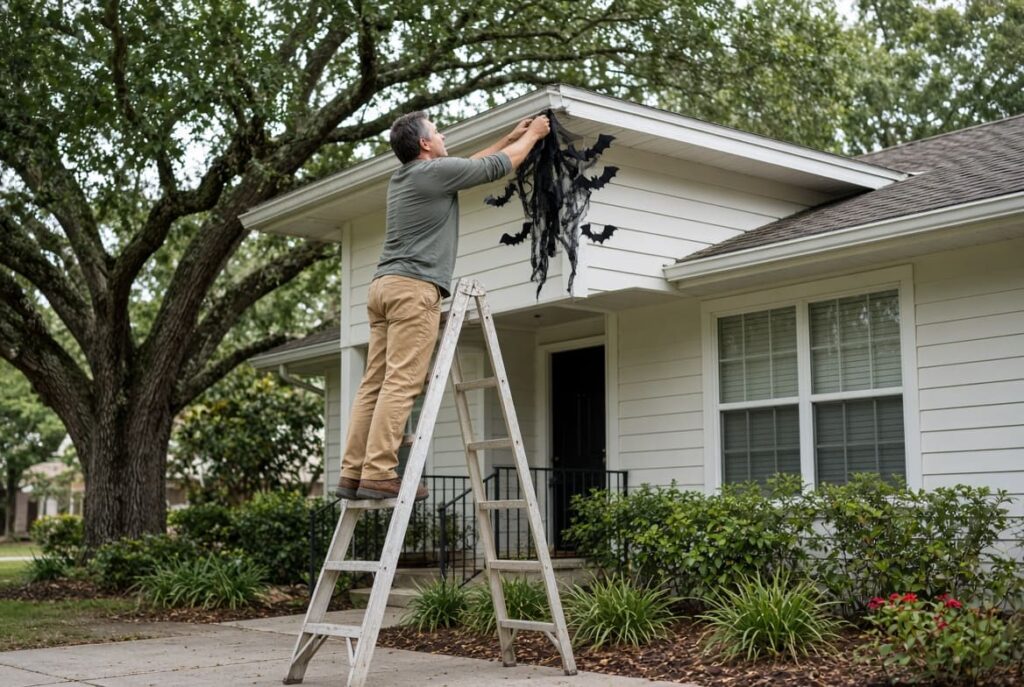
Reaching overhead on a ladder. Hanging lights, ghost decorations, or spiderwebs requires sustained overhead reaching, often with the head tilted back and one arm extended farther than the other. Ladder falls are the most visible risk—Consumer Product Safety Commission data consistently show falls as a leading cause of holiday-decorating injuries, with ladders involved in a large share of the more serious cases—but even without a fall the position itself strains the neck, upper thoracic spine, and shoulders. Looking up for long periods tightens the suboccipital muscles and can irritate the cervical joints. People also lean or twist past the ladder rails to reach one more hook, which loads the lower back in an unstable position.
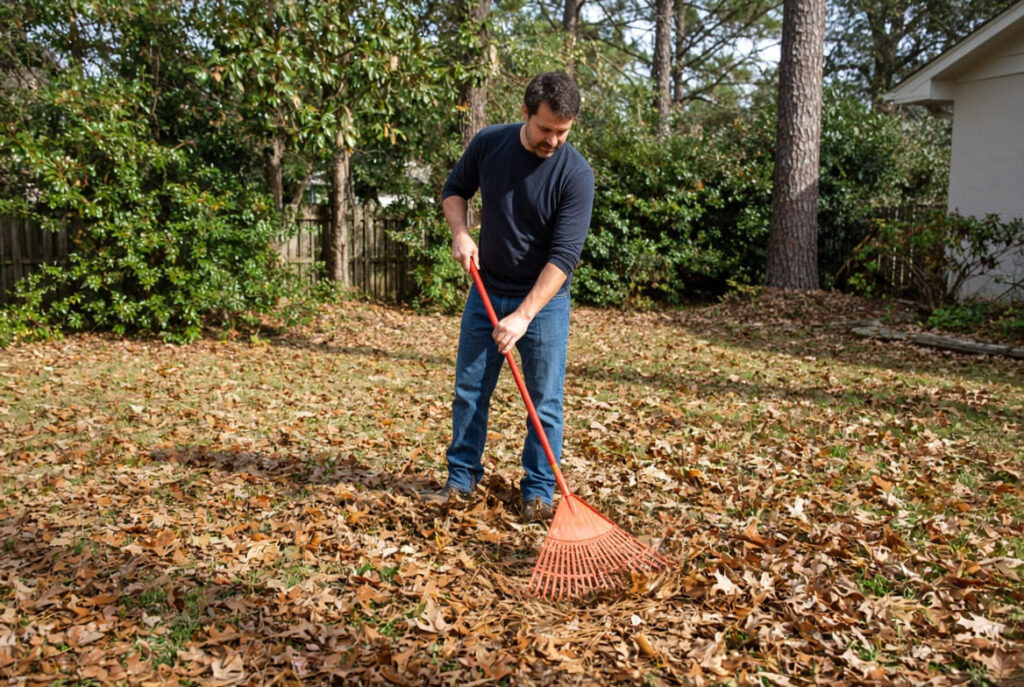
Raking with a rounded back. Oak leaves and pine straw in Jacksonville are heavy when damp. Raking involves hundreds of repeated pulls with the arms while the trunk stays flexed and often rotated to one side. When the back is rounded, the lumbar discs are under more pressure and the erector spinae and multifidus muscles fatigue. Once those stabilizers tire, the passive structures (discs, ligaments, facet joints) take a larger share of the load. Shoulders and forearms also take a beating from the gripping and pulling motion. Analyses of emergency-room data have shown that a meaningful percentage of raking-related visits involve the back, and clinicians routinely describe the “rake, bag, lift” sequence as a common October trigger for lumbar strain or disc irritation.
Leftover storm cleanup adds another layer. Broken limbs, heavier debris, and uneven ground from wind or rain increase both the load and the chance of a sudden misstep. All of these tasks are done by people who may not have trained the trunk or hips for that volume of work. A summer of desk time or driving does not prepare the body for four hours of raking and lifting on a Saturday.
Safer Ways to Handle the Work
Small changes in setup and technique reduce the stress dramatically.
For bins and bags, test the weight first. If a bin feels heavy, empty half of it or make two trips. Stand close to the load, bend at the hips and knees rather than rounding the lower back, keep the object against your torso, and turn by moving your feet instead of twisting the spine. Set the bin down the same way you picked it up—controlled, close, and with the legs doing the work. Wet leaf or pine-straw bags are worse because they shift; fill them less full and use a tarp or wheelbarrow when possible so you are not carrying awkward loads across the yard.

On the ladder, place it on firm, level ground and check that it is fully open and locked. Have someone spot you. Move the ladder rather than reaching far to one side. Keep your belt buckle between the rails and avoid leaning backward. The American Academy of Orthopaedic Surgeons notes the classic four-to-one rule for ladder angle (base one foot out for every four feet of height) and reminds people not to stand on the top steps of a stepladder. Battery-operated lights reduce the need to manage cords while elevated. If you feel unsteady or the ground is soft from recent rain, postpone the higher work.
For raking, choose a rake whose length lets you stay relatively upright. Alternate sides every few minutes so one set of muscles is not doing all the rotation. Keep the rake closer to your body and use a push-pull motion rather than large twisting sweeps. Take a short break every 20–30 minutes to stand tall, walk a few steps, and reset your posture. Bagging is often the higher-risk moment; keep bags lighter and lift them with the same hip-and-knee hinge used for bins.
Break the whole job into shorter sessions. Two 45-minute blocks with a real break are kinder to the spine than one long push until everything is finished.
A Short Pre-Chore Warm-Up
Cold muscles and stiff joints are more likely to be injured under load. Five to seven minutes of easy movement before you start raises tissue temperature, improves joint lubrication, and activates the muscles that stabilize the trunk and hips. Do this in the yard or driveway so it feels like part of the task rather than a separate workout.
- March in place or walk around the yard for 30–60 seconds to raise heart rate slightly.
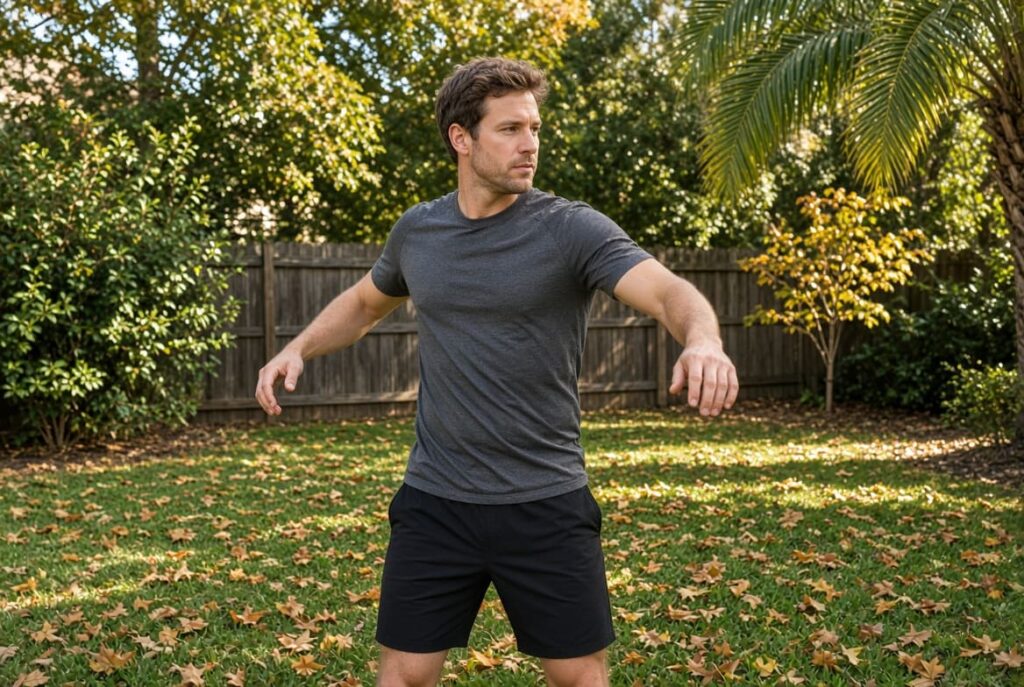
- Arm swings: swing both arms across the body and then open wide, 10–12 times. This loosens the shoulders and upper back for reaching and raking.
- Torso twists: stand with feet shoulder-width, hands on hips or lightly crossed at the chest, and rotate slowly side to side, 8–10 each direction. Keep the movement controlled and the feet planted so the rotation comes from the mid-back rather than the lower back.
- Hip circles or leg swings: hold a fence or wall for balance and swing one leg forward and back or in a controlled circle, 5–8 each direction, then switch. This mobilizes the hips so you can bend at the hips instead of the lower back.
- Standing hip-flexor stretch: step into a shallow lunge, keep the back leg straight and torso tall, and gently press the hips forward for 20–30 seconds each side. Tight hip flexors from sitting are a common reason the lower back compensates during lifting.
- Gentle back extension: stand tall, place hands on the lower back or hips, and slowly arch backward a small amount, then return to neutral, 8–10 times. This counters the rounded posture of raking and bin work.
- Shoulder-blade squeezes: pull the shoulder blades down and together, hold two seconds, release, 10 times. This helps prepare the upper back for overhead work.
The whole sequence takes less time than finding the right extension cord. If any movement feels sharp or pinchy, reduce the range or skip that one. The goal is readiness, not a full stretch session.
After the work, a few reverse movements help: cat-cow on hands and knees or a gentle standing side bend, plus a short walk. Heat on the low back later that evening is usually more comfortable than ice once the acute phase has passed, unless there is clear swelling.
When an Ache Is Worth Getting Checked Before It Becomes a November Problem
Mild muscle soreness that improves over two or three days with ordinary movement, heat, and lighter activity is common after a bigger weekend of yard work. Sharp pain, pain that worsens each day, pain that radiates into the buttock or leg, numbness or tingling, weakness, or pain that interferes with sleep, walking, or getting dressed is different. Those signs suggest the load may have irritated a disc, facet joint, or nerve root rather than simply fatigued a muscle.
A practical rule many clinicians use is to give uncomplicated-looking stiffness three to five days of relative rest, gentle movement, and basic self-care. If it is clearly improving, continuing that approach is reasonable. If it is not improving, if it is spreading, or if ordinary daily movements are still limited, an evaluation is worthwhile before the pattern sets in and becomes harder to reverse. Red-flag symptoms—loss of bladder or bowel control, saddle numbness, or profound leg weakness—need immediate medical attention, not a wait-and-see approach.
Chiropractic evaluation is particularly useful for these mechanical issues. A careful history and examination can distinguish a simple muscle strain from joint restriction, disc irritation, or compensatory patterns that developed because the hips or mid-back were stiff. Treatment can include specific adjustments to restore motion, soft-tissue work for the overworked muscles, and practical advice on movement so the same weekend next year is less likely to create the same problem. Many people in Jacksonville also have residual effects from previous storm cleanup or from long hours of sitting; addressing those underlying restrictions often shortens recovery.

Putting It Together for the Rest of the Season
Jacksonville’s late-October and early-November mix of decorations, oak and pine debris, and occasional leftover storm material is predictable. So are the ways the back gets overloaded. Treat the work like the moderate physical task it is: warm up briefly, keep loads close and feet moving when you turn, stay inside the ladder rails, alternate sides while raking, and stop before fatigue forces poor form. Listen to the difference between ordinary post-work stiffness and pain that is not settling.
If an ache from this weekend’s decorating or cleanup is still limiting you a few days later, or if you want to get ahead of the pattern before the next round of yard work, a focused evaluation can clarify what is happening and what will help it resolve. At ChiroCure Health Center we see these seasonal issues regularly and can help you get back to moving comfortably without turning a one-weekend project into a longer problem.
Ready to get that checked or simply want to stay ahead of the next cleanup? Call (904) 616-8454 or book online at ChiroCureCenter.com. We’re located at 8833 Perimeter Park Blvd, Ste 102, Phase II, Jacksonville, FL 32216 and can usually get you in quickly.