

If you’ve ever picked up a racquet, swung a hammer, typed for hours, or even carried groceries and felt a sharp, burning pain on the outside of your elbow that radiates down your forearm, you may be dealing with tennis elbow. Also known as lateral epicondylitis, this common overuse injury affects millions of people each year—not just professional athletes. According to the Mayo Clinic, tennis elbow is the most frequent cause of elbow pain in adults, impacting up to 3% of the population annually.
At ChiroCure Health Center in Jacksonville, Florida, we see patients from all walks of life—busy parents, weekend warriors, office workers, and professional truck drivers—struggling with this frustrating condition. The good news? You don’t have to rely on pain medications, steroid injections, or surgery to recover. Gentle, evidence-based chiropractic care addresses the root cause of tennis elbow, helping restore mobility, reduce inflammation, and prevent recurrence—naturally.
In this comprehensive guide, we’ll break down everything you need to know about tennis elbow: its causes, symptoms, conventional treatments, and—most importantly—how the team at ChiroCure Health Center can help you get back to the activities you love.
What Exactly Is Tennis Elbow (Lateral Epicondylitis)?
Tennis elbow is a painful condition caused by damage to the tendons that attach the forearm muscles to the bony bump on the outside of your elbow (the lateral epicondyle). Despite its name, less than 5% of cases actually come from playing tennis. It’s an overuse injury where repetitive stress leads to microscopic tears in the extensor carpi radialis brevis (ECRB) tendon—the primary muscle responsible for wrist extension (Nirschl & Ashman, 2003).
Anatomically, the forearm extensors work hard during gripping, lifting, and twisting motions. When these tendons are overloaded without adequate recovery, inflammation, scar tissue, and degeneration set in. Unlike acute injuries, tennis elbow develops gradually, often over weeks or months. Left untreated, it can become chronic, affecting grip strength, sleep, and daily tasks like turning a doorknob or shaking hands.
At ChiroCure Health Center, we explain to patients that tennis elbow isn’t just “elbow pain”—it’s a signal that the entire kinetic chain (wrist, elbow, shoulder, and even neck) may be out of alignment. This holistic understanding sets chiropractic care apart from symptom-focused approaches.
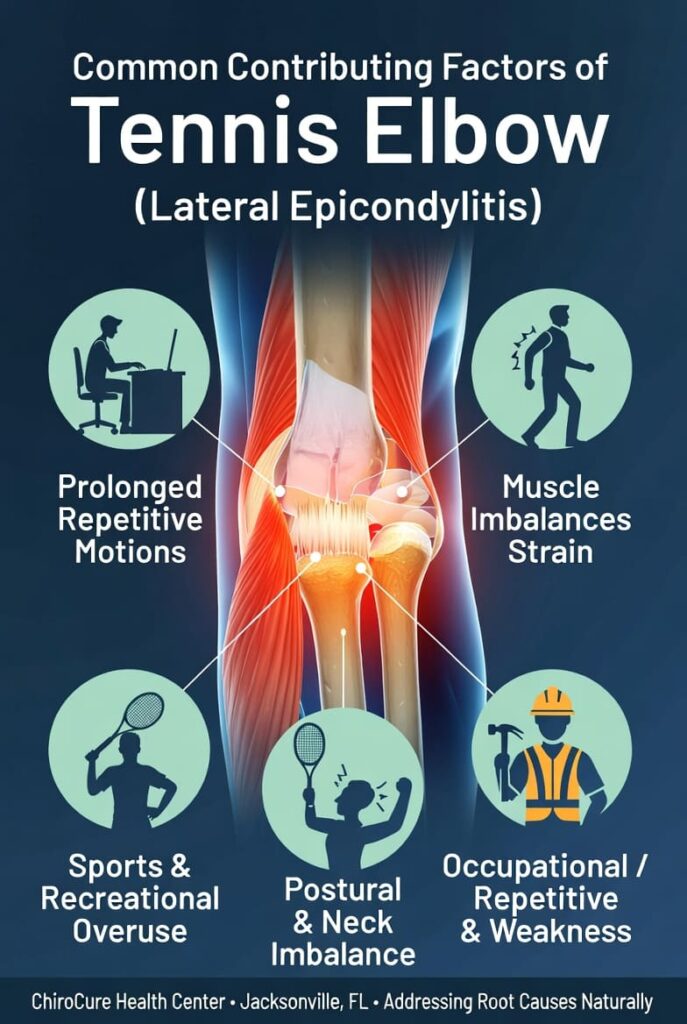
Common Causes and Risk Factors
Overuse is the primary culprit, but multiple factors contribute:
- Repetitive wrist and arm motions: Typing, mouse use, painting, plumbing, carpentry, or racquet sports.
- Poor ergonomics: Awkward workstation setup or improper sports technique (e.g., tennis backhand with a locked elbow).
- Age and occupation: Most common between ages 30-50. Jobs requiring gripping tools or repetitive motions (truck drivers, chefs, construction workers) increase risk.
- Muscle imbalances: Weak shoulder stabilizers or tight forearm muscles place extra load on the elbow.
- Sudden increases in activity: Starting a new workout routine or returning to tennis after a break.
Other contributors include direct trauma, poor posture, or even cervical spine issues that refer pain to the arm. Research also shows that dysfunction in the cervical spine and upper back can contribute significantly to elbow symptoms because of nerve and muscle interconnections (Vicenzino et al., 2007).
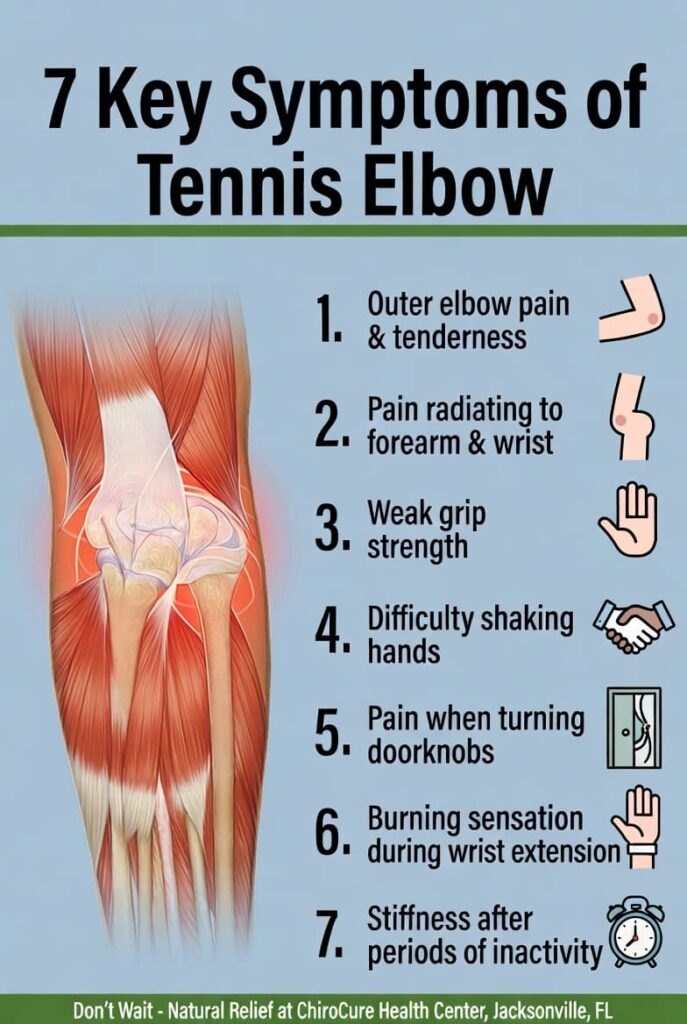
Recognizing the Symptoms
The hallmark symptom is pain and tenderness on the outside of the elbow, often worsening with gripping, lifting, wrist extension, or forearm twisting. Pain may radiate into the forearm and wrist, along with weakness, stiffness, and burning sensations (Mayo Clinic, 2023).
Diagnosis and Conventional Treatments
Diagnosis is usually clinical, using tests such as Cozen’s test or Mill’s test. Imaging may be used to rule out other conditions. Conventional treatments often include rest, ice, NSAIDs, bracing, physical therapy, corticosteroid injections, and in rare cases, surgery (Bisset et al., 2005; Coombes et al., 2010).
While these can provide short-term relief, many patients experience recurring symptoms or side effects from medications and injections.
Why Chiropractic Care at ChiroCure Health Center Is Highly Effective for Tennis Elbow
Chiropractic doesn’t just mask pain; it restores proper biomechanics so the body can heal itself. Here’s how we help patients at our Jacksonville clinic:
- Chiropractic Adjustments: Gentle, specific adjustments to the wrist, elbow, shoulder, and cervical spine reduce joint restrictions, improve nerve flow, and decrease muscle tension. Research and clinical experience show that addressing cervical spine dysfunction often provides dramatic elbow relief.
- Myofascial Release & Kinesiotaping: Our targeted soft-tissue therapies (exactly like those listed in our Services page) break up adhesions in the forearm extensors and support proper muscle firing. Kinesiotape helps reduce swelling and improve circulation during daily activities.
- Therapeutic Ultrasound & Interferential Electro-Therapy: These modalities penetrate deep tissues to reduce inflammation, promote healing, and relax spasms—perfect complements to adjustments for sports injuries and repetitive strain.
- Customized Exercise Programs: We teach patients safe, progressive strengthening and stretching routines (more on this below) to rebuild tendon resilience.
- Nutritional Counseling & Holistic Support: Anti-inflammatory diet recommendations and lifestyle advice accelerate recovery.
Studies support the use of manual therapy and spinal manipulation for lateral epicondylitis, showing good outcomes in pain reduction and function (Vicenzino et al., 2007; Fernández-de-Las-Peñas et al., 2015).
Learn more about what happens during a chiropractic adjustment in our dedicated blog post: What Happens During a Chiropractic Adjustment?.
Proven Exercises for Recovery and Prevention
Eccentric strengthening is gold-standard for tendon healing. Here’s a simple home program (always get cleared by your chiropractor first):
- Wrist Extension Eccentrics (Tyler Twist variation): Hold a light dumbbell (1-3 lbs). With palm down, use your good hand to lift the weight, then slowly lower with the affected arm. 3 sets of 10-15 reps, 5-7 days/week.
- Wrist Flexor Stretch: Extend arm, palm up, gently pull fingers back with opposite hand. Hold 20-30 seconds, repeat 3-5 times.
- Forearm Supination/Pronation: Hold a hammer or dumbbell, rotate forearm slowly.
- Shoulder & Posture Exercises: Wall angels or Y-T-I raises to strengthen the entire upper chain.
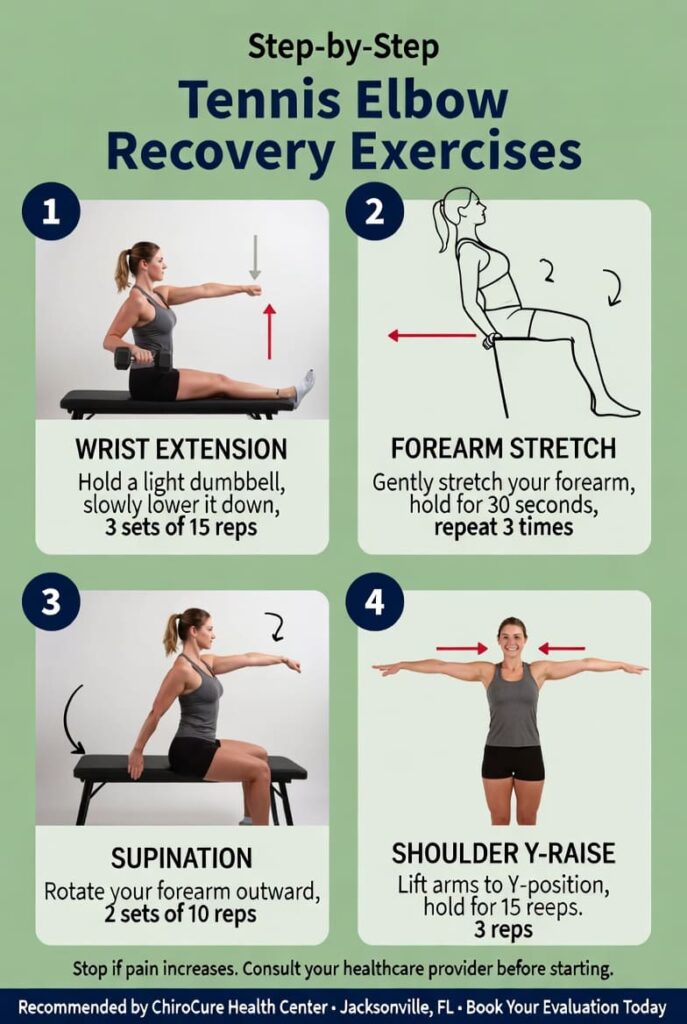
Incorporate these into your routine and combine with in-office care for best results. Visit our Services page to see how myofascial release pairs perfectly with these exercises.
When to Seek Professional Help at ChiroCure Health Center
Preventive strategies include proper ergonomics, regular strengthening of the upper body, technique correction, and taking micro-breaks during repetitive tasks.
If pain persists beyond 2 weeks, interferes with sleep or work, or you notice swelling/redness, it’s time to act. Contact ChiroCure Health Center for a comprehensive evaluation.
Ready for relief? Book your appointment online or call (904) 616-8454.
Prevention Tips for Long-Term Elbow Health
- Maintain proper ergonomics at work and play.
- Warm up before activities and use correct technique.
- Strengthen the entire upper body regularly.
- Take micro-breaks during repetitive tasks.
- Stay hydrated and eat anti-inflammatory foods (supported by our nutritional counseling).
Conclusion: Take Control of Your Tennis Elbow Naturally
Tennis elbow doesn’t have to sideline you. With the right approach—combining education, targeted chiropractic care, and supportive therapies—you can achieve lasting relief and stronger, more resilient arms. At ChiroCure Health Center, our mission is simple: help Jacksonville families and athletes experience the quality of life they deserve through gentle, drug-free care.
Don’t wait for the pain to worsen. Explore our full range of services here, read more wellness tips on our blog, or contact us today. Your elbows (and your future self) will thank you.
References
- Mayo Clinic. (2023). Tennis elbow – Symptoms and causes. https://www.mayoclinic.org/diseases-conditions/tennis-elbow/symptoms-causes/syc-20351987
- Nirschl, R. P., & Ashman, E. S. (2003). Elbow tendinopathy: tennis elbow. Clinics in Sports Medicine, 22(4), 813–836.
- Vicenzino, B., Cleland, J. A., & Fernandez-de-las-Penas, C. (2007). The clinical and research implications of manual therapy for lateral epicondylalgia. Journal of Manual & Manipulative Therapy, 15(4), 206–213.
- Bisset, L., Paungmali, A., Vicenzino, B., & Beller, E. (2005). A systematic review and meta-analysis of clinical trials on physical interventions for lateral epicondylalgia. British Journal of Sports Medicine, 39(7), 411–422.
- Coombes, B. K., Bisset, L., & Vicenzino, B. (2010). Efficacy and safety of corticosteroid injections and other injections for management of tendinopathy: a systematic review of randomised controlled trials. The Lancet, 376(9754), 1751–1767.
- Fernández-de-Las-Peñas, C., et al. (2015). Manual therapy for lateral epicondylalgia: a systematic review and meta-analysis. Physical Therapy Reviews, 20(1), 1–10.