
A practical guide from ChiroCure Health Center for Jacksonville families, desk workers, athletes, and commercial drivers.

If you live or work in Jacksonville, you already know how easy it is to sit still. Long commutes on I-95 and I-295. Hours at a desk. Evenings on the couch after a hot, humid day. For commercial drivers, the pattern is even more extreme: hours in a seat, then a short walk to a rest stop, then more sitting. Over time, that stillness shows up as a stiff neck, a tight low back, aching hips, tension headaches, and the feeling that your body has rusted in place.
At ChiroCure Health Center, we hear a version of this story every week. Patients often arrive hoping for a quick fix—and many have already tried pills that only quiet the alarm without repairing the wiring. September is Drug-Free Pain Management Awareness Month, and it is a good moment to say something simple that research and clinical experience keep confirming: movement is medicine. Not frantic exercise. Not a punishing gym program. Daily, honest movement that your joints, discs, muscles, and nervous system were designed to receive.
This article expands the ideas in our “Movement Heals” patient guide and explains how daily activity reduces pain without drugs. It also shows how chiropractic care and movement work together. The self-care principles below draw on guidance consistent with Mayo Clinic’s Back Pain Basics and Self-Care Tips (2024) and on what Dr. Emilio Cosio sees in practice at our Perimeter Park clinic.
The Problem With “Rest Until It Stops Hurting”
When your back or neck flares, the couch looks like the safest option. For one or two days after a true strain, easing off intense activity can be reasonable. But prolonged rest is one of the most common mistakes people make with musculoskeletal pain.
Mayo Clinic and other major medical groups have been clear on this point for years: bed rest is not the default treatment for most back pain. Light activity and continued daily movement usually help recovery more than staying still. People who remain as active as they can tolerate tend to recover faster than people who take to bed. Movement keeps joints lubricated, muscles from guarding, and blood flowing into tissues that need to heal.
Think of a rusty gate. If you never open it, the hinges seize. If you force it violently, you snap the hardware. If you move it a little, often, with oil and good alignment, it starts to swing again. Your spine, hips, and shoulders work the same way.
That is why “take it easy” should never mean “stop moving.” It should mean “move in a way your body can currently handle, then build from there.”
Why Movement Matters
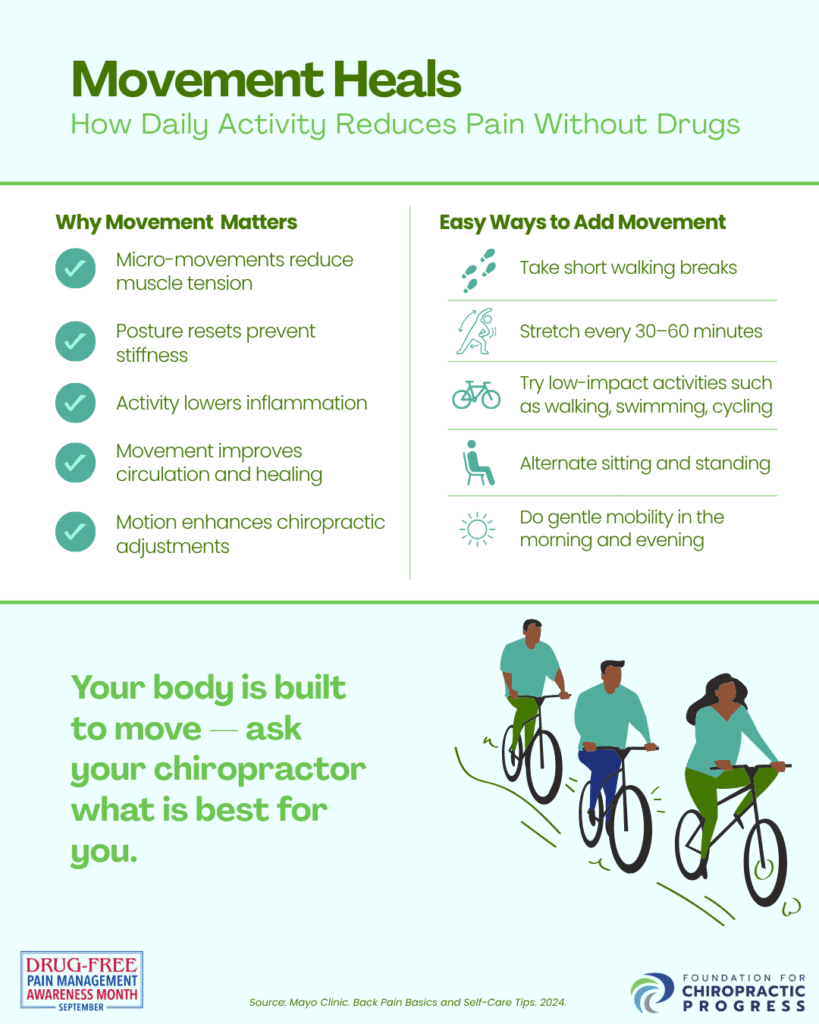
The five reasons on the graphic are not slogans. Each one maps to a real change in your tissues.
1. Micro-movements reduce muscle tension
Muscles that hold one position too long—whether you are hunched over a laptop, gripping a steering wheel, or standing on a concrete warehouse floor—begin to guard. Guarding is a protective reflex. It feels like tightness, knots, or a band of pressure across the shoulders or low back. Tiny, frequent movements interrupt that reflex. Rolling your shoulders, standing up to reach a high shelf, walking to refill a water bottle, or gently rocking your pelvis in the chair all tell the nervous system, “We are safe. You can let go.”
You do not need a 45-minute workout to get this benefit. You need dozens of small permission slips for your muscles to unclench. Over a full workday, those micro-movements add up to less end-of-day stiffness and fewer evening pain spikes.
2. Posture resets prevent stiffness
There is no single “perfect posture” you must hold all day. The posture that hurts people is the one they never change. When the head drifts forward and the mid-back rounds, the joints in the neck and upper back lose their normal motion. Ligaments creep. Discs take uneven load. A posture reset is a brief return to a taller, more balanced position—chin slightly tucked, ribs stacked over pelvis, weight shared through both feet.
Set a reminder every 30 to 60 minutes. Stand. Look toward the horizon. Roll the shoulders back and down. Take three slow breaths. That 20-second reset does more for stiffness than an expensive chair that still leaves you frozen in one shape for four hours.
3. Activity lowers inflammation
Chronic sitting and chronic inactivity are associated with higher levels of systemic inflammation. Regular, moderate movement does the opposite. Muscle contractions help circulate immune cells and lymphatic fluid. Low-impact aerobic activity—walking, swimming, easy cycling—is consistently linked with lower inflammatory markers and better pain tolerance. This is one reason patients who start a walking habit often report that “everything hurts a little less,” even in joints they were not targeting.
Inflammation is not the enemy in the first 48 hours after an acute sprain. It is part of healing. The problem is the smoldering, low-grade inflammation that comes from never moving enough. Daily activity turns down that background noise.
4. Movement improves circulation and healing

Soft tissues heal in a moving environment. Blood brings oxygen and nutrients. Motion helps synovial fluid bathe cartilage. Walking is especially useful because it is rhythmic, load-bearing, and easy to dose. You can start with five minutes and add two minutes every few days. For many Jacksonville patients, the best “clinic” between visits is a shaded path at a local park, a lap around the Perimeter Park complex, or an evening walk after the heat drops.
Circulation also matters after a chiropractic adjustment. When joints move better, surrounding muscles can share the work instead of bracing. Better blood flow then helps those tissues recover from the extra work they have been doing for months.
5. Motion enhances chiropractic adjustments
This is the point patients feel most clearly. An adjustment restores motion to a restricted joint. If you return to eight hours of motionless sitting, that joint has little chance to “practice” its new range. If you walk, stretch, and change positions the same day, the nervous system and the surrounding muscles learn the new pattern. Adjustments last longer. Visits become less about putting out fires and more about building capacity.
Dr. Cosio often tells patients that the adjustment is the spark. Daily movement is the fuel. One without the other still helps. Together, they change the trajectory of pain.
Easy Ways to Add Movement (That You Will Actually Do)
The second half of the graphic is deliberately ordinary. High-intensity programs fail when people are already hurting. The goal is a life with more motion in it, not a new identity as an athlete by Friday.
Take short walking breaks
Set a timer for 45 to 60 minutes if you work at a desk or drive locally between stops. Stand up and walk for three to five minutes. That can be a hallway, a parking lot loop, or a slow lap around the building. For CDL drivers between loads, even a walk around the truck, calf raises on a curb, and shoulder rolls are better than another 20 minutes in the cab with the seat reclined.
If you can stack a 20- to 30-minute walk most days, even better. Jacksonville’s early mornings and later evenings are the kindest windows in September heat. Walk as if you are late for nothing. Let the arms swing. Let the eyes look farther than a phone screen.
Stretch every 30–60 minutes
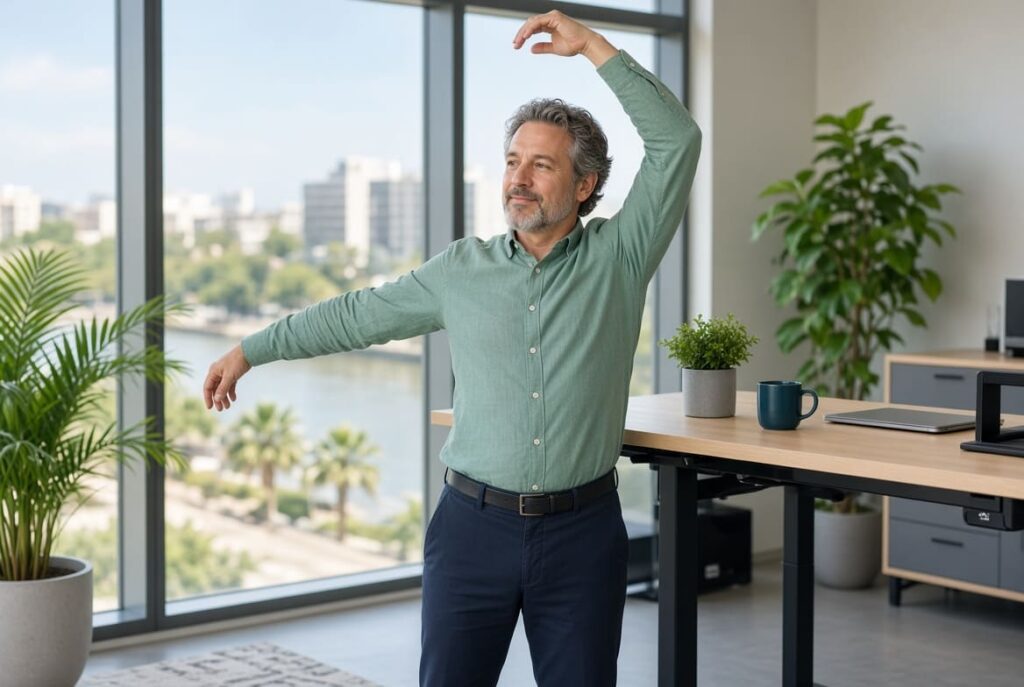
You do not need a yoga class in the break room. You need a short menu you can do in work clothes:
- Chin tuck: slide the head straight back as if making a double chin. Hold 5 seconds. Repeat 5 times.
- Shoulder blade squeeze: draw the shoulder blades down and together. Hold 5 seconds. Repeat 8 times.
- Standing side bend: reach one arm overhead and lean gently away. Breathe into the ribs. Switch sides.
- Hip flexor opener: stand in a short lunge, tuck the pelvis under, and feel the front of the back hip. Hold 20–30 seconds each side.
- Seated figure-four: cross an ankle over the opposite knee and hinge forward a few inches until you feel the outer hip.
Stop any motion that sends sharp, shooting, or worsening pain down an arm or leg. A stretch should feel like a release, not a test of courage.
Try low-impact activities: walking, swimming, cycling
Mayo Clinic specifically recommends walking, swimming, and other low-impact aerobic activity to strengthen the back and support recovery. These three options cover almost every Jacksonville lifestyle:
- Walking is the default. It requires shoes, not a membership. Neighborhood loops, the riverwalk, school tracks after hours, and shaded park paths all count.
- Swimming and water walking unload the spine while the water provides gentle resistance. This is often the best choice during a flare or for patients with irritable joints.
- Cycling, especially on a path or a well-fit stationary bike, trains the hips and legs without pounding. Raise the handlebars if your neck complains. A recumbent bike is a valid option, not a lesser one.
What you should usually avoid during a back flare is high-impact work: jumping, aggressive twisting, heavy toe-touch stretching, and lifting from a rounded spine. Build capacity first. Intensity can come later.
Alternate sitting and standing
A standing desk is helpful only if you use both positions. Standing all day creates its own problems in the feet, knees, and low back. The winning pattern is a rhythm: sit for 30–40 minutes, stand for 10–20, walk for 3–5, repeat. If you do not have a standing desk, stand for phone calls. Stand while you sort mail. Stand during the first five minutes of a meeting. Put a water bottle on a high shelf so you have a reason to get up.
Drivers cannot stand on the highway, but they can use every stop. When the truck is parked, stand, walk, and open the hips before the next stretch of road. Those minutes protect the lumbar discs that spend the rest of the day under compression.
Do gentle mobility in the morning and evening
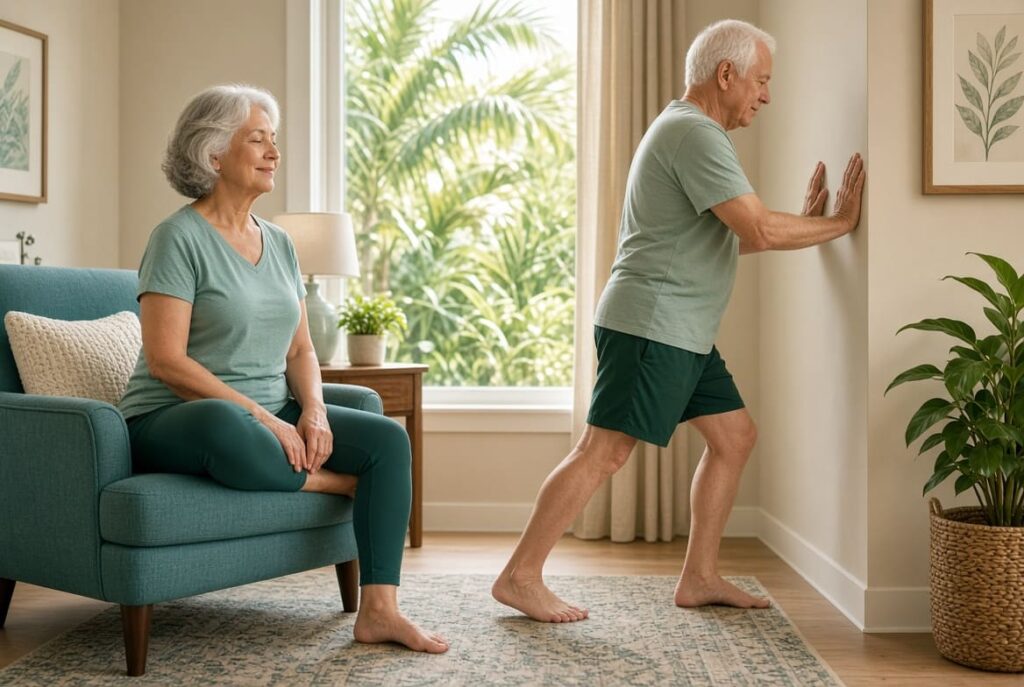
Your spine is typically stiffest in the morning because discs have taken on fluid overnight. A gentle 6- to 10-minute routine before you rush into the day pays rent on the next 12 hours. In the evening, the same routine tells guarded muscles that the workday is over.
A simple bookend routine we often recommend:
- Lie on your back and slowly hug one knee to the chest, then the other, then both. Hold each for 5–10 seconds.
- With knees bent and feet on the floor, gently roll both knees a few inches to one side, then the other. Keep the shoulders quiet.
- Pelvic tilts: flatten the low back into the floor, then release. Ten slow repetitions.
- Bridge: press through the heels and lift the hips until the body makes a line from knees to shoulders. Hold 5 seconds. Repeat 8 times if comfortable.
- Finish standing with 10 slow heel raises and 5 easy shoulder rolls in each direction.
These movements are consistent with commonly recommended back-care exercises from sources such as Mayo Clinic. They are a starting template, not a prescription. If you have had surgery, osteoporosis, an acute disc flare with leg weakness, or unexplained weight loss and fever with back pain, get examined before you start a home program.
How Chiropractic Care and Daily Movement Work Together

Chiropractic care at ChiroCure Health Center is not a substitute for living in your body. It is a way to remove the roadblocks that make living in your body painful.
When a spinal joint or an extremity joint loses motion, the body compensates. Other segments move too much. Muscles on one side work overtime. Nerves can become irritated. Pain then teaches you to move even less, which tightens the trap. A gentle, specific adjustment—using a high-velocity, low-amplitude technique when appropriate, or a slower mobilization when that is safer—helps restore that missing motion.
Around the adjustment, we use the tools that help tissue actually change:
- Therapeutic ultrasound to encourage circulation and reduce local irritability in tight or inflamed tissue.
- Interferential electro-therapy to calm muscle spasm and make movement more tolerable.
- Myofascial release and kinesiotaping to take pressure off guarded soft tissue and support a joint while you retrain it.
- Corrective exercises and nutritional counseling so the change you feel in the office survives the rest of the week.
This is the same philosophy that led Dr. Cosio to open the clinic in 2016 after years of working alongside medical doctors, pediatricians, and nurse practitioners across Jacksonville. Pain is rarely just a spine problem or just a muscle problem or just a lifestyle problem. It is usually all three. Treating only one of them is why so many people bounce from prescription to prescription.
What This Looks Like in Real Jacksonville Lives
The desk-bound professional
A project manager spends nine hours on video calls, then sits in traffic on Southside Boulevard. By Thursday the right shoulder is in the ear and a tension headache is waiting at 3 p.m. The plan is not a boot camp. It is a standing-call rule, a 12-minute lunch walk, hourly chin tucks, and a weekly adjustment plus soft-tissue work until the neck stops locking. Within a few weeks, the headache days drop because the neck is no longer held in a vise from Monday to Friday.
The parent who “doesn’t have time”
Parents in our clinic often say they cannot exercise because they are already lifting children, groceries, and laundry. That is work, but it is not recovery movement. The difference is variety and control. Ten minutes of floor mobility after the kids are in bed, a Saturday bike ride on a quiet path, and coaching on how to hip-hinge when lifting a car seat will do more for a parent’s back than another bottle of ibuprofen in the console.
The commercial driver
DOT physicals are a large part of our week, and they give us a window into the bodies that keep freight moving through Florida. Drivers sit more than almost any other profession. Many already know their backs, knees, and blood pressure are under stress. Movement between loads, calf and hip openers at every fuel stop, and chiropractic care for the lumbar and thoracic restrictions that come from a seat and a steering wheel are not extras. They are how a career lasts. If you are due for a DOT physical, it is also a good time to mention the pain you have been “just living with.” The exam and a musculoskeletal visit can happen in the same building.
Seniors who are afraid to start
Fear of falling or “making it worse” keeps many older adults still, and stillness is what makes the next fall more likely. Chair-supported mobility, short walks with a friend, water exercise, and gentle adjustments appropriate for age and bone density are a safer path than doing nothing until a crisis. Motion is how balance, confidence, and independence are maintained.
A Simple 7-Day Movement Starter Plan
Use this as a template. Shrink any day that flares symptoms. Expand any day that feels easy.
- Every day: morning 8-minute mobility + evening 8-minute mobility. Hourly 60-second posture reset while you work.
- Monday / Wednesday / Friday: 15–25 minute easy walk. Add two minutes each week if you feel good.
- Tuesday / Thursday: walk 10 minutes or cycle 15 minutes, plus 2 sets of bridges and heel raises.
- Saturday: a longer enjoyable activity—family walk, easy bike ride, swim, or a lap around a park.
- Sunday: mobility + a slower walk. Review what felt good and what needs to be smaller next week.
Pair the plan with water, regular sleep, and less time folded over a phone. Those three habits multiply the effect of everything else.
When Movement Is Not Enough on Its Own
Daily activity is powerful. It is not a diagnosis, and it is not a reason to ignore warning signs. Schedule an exam promptly if you have any of the following:
- Pain that travels below the knee or into the arm with numbness, tingling, or weakness.
- Back pain with unexplained fever, night pain that does not change with position, or unplanned weight loss.
- Loss of bowel or bladder control, or progressive leg weakness. That is an emergency.
- Pain after a fall, accident, or lift that is getting worse instead of better after several days.
- Pain that keeps returning in the same place no matter how carefully you stretch.
Those patterns often mean a joint restriction, disc irritation, or movement fault that will not stretch itself away. That is exactly when a detailed exam helps. Dr. Cosio starts with history, orthopedic testing, and motion analysis, then builds a plan that fits your age, work, and goals—whether you are a child, a pregnant patient, a senior, an athlete, or a driver who needs to stay medically qualified.
Your Body Is Built to Move — Ask What Is Best for You
The last line on the patient graphic is the most important one. Generic advice on the internet cannot see your disc, your workstation, your delivery schedule, or the old ankle sprain that still changes your gait. Personalized guidance can.
At ChiroCure Health Center we do not mask pain with medication or rush anyone toward surgery. We treat the reason the tissue is unhappy: restricted joints, guarded muscles, poor movement habits, and the daily positions that keep rebuilding the same problem. Then we give you a movement plan you can live with in Jacksonville heat, in a cab, at a desk, or on the floor with your kids.
Quality of life means everything. Being able to walk the park, finish a shift, sleep through the night, and get on the floor without bargaining with your back is not a luxury. It is what a body is for.
Ready to move with less pain?
Book a visit at ChiroCure Health Center — 8833 Perimeter Park Blvd, Ste 102, PHASE II, Jacksonville, FL 32216.
Call (904) 616-8454 or book online at chirocurecenter.janeapp.com.
Office hours: Mon–Thu 9am–5pm, Fri 9am–2pm. Same-day appointments are often available.
GPS note: continue to Phase II (8833). Mapping apps sometimes send people to Phase I (8825) by mistake.
Educational note. This article is for general education and is not a diagnosis or a treatment plan. Individual recommendations should come from a licensed clinician who has examined you. Source referenced in the companion graphic: Mayo Clinic, Back Pain Basics and Self-Care Tips, 2024. Additional background is consistent with Mayo Clinic patient guidance on staying active with back pain and using walking, swimming, and other low-impact activity as part of recovery.
About the clinic. ChiroCure Health Center is Jacksonville’s trusted family chiropractic clinic, founded in 2016 by board-certified chiropractic physician Dr. Emilio Cosio. The clinic provides gentle, drug-free chiropractic adjustments, soft-tissue therapies, corrective exercise guidance, nutritional counseling, and FMCSA-compliant DOT physicals. chirocurecenter.com